Zombie apocalypse 01

What if the zombie apocalypse happened? How could I survive?


If the movies have taught us anything, it’s that the initial panic kills far more people than the actual monsters. When the dead start walking, your biggest asset isn’t a massive arsenal—it’s situational awareness and a cold, calculating approach to logistics.

Realistically, survival breaks down into immediate crisis management and long-term sustainability. Here is your blueprint for making it through.

Phase 1: The First 24 Hours

The initial breakout will be pure, unadulterated chaos. The streets will be gridlocked, emergency services will collapse, and public panic will be at its peak. Your immediate goal is to stay out of the fray.

1.Lock down and blackout: Immediate.

Lock every door and window. Draw all blinds and curtains. You want total visual and acoustic blackout. If the infected (or desperate neighbors) don’t know you’re there, they have no reason to break in.

2.Secure the water grid: Within 1 hour.

Fill your bathtub, sinks, washing machine, and every empty container with water. The municipal water grid will likely fail or become contaminated within days. You can live for weeks without food, but only three days without water.

3.Inventory your assets: Within 3 hours.

Lay out every scrap of food, first-aid supplies, tools, and potential weapons. Calculate your caloric burn and plan a strict rationing schedule immediately—do not wait until you are down to your last can of soup.

4.Hold your ground: The first 72 hours.

Do not try to flee the city or join the mass exodus. The highways will be death traps. Stay put, stay quiet, and let the worst of the initial panic burn itself out outside your walls.


Phase 2: The Long-Term Essentials

Once the initial shockwave settles, survival becomes a game of resource management.

1. Water & Food

Forget foraging for gourmet meals. You need calories and hydration.

  • Water First: Learn how to harvest water from hot water heaters, toilet tanks (the upper reservoir, not the bowl), and rain collection. Stock up on unscented liquid bleach—just 2 drops per quart of clear water will kill most pathogens.

  • The Pantry: Focus on high-calorie, non-perishable items that don’t require cooking. Peanut butter, canned beans, oats, and honey are gold standard survival foods.

2. Shelter Strategy

Your current home is fine for the short term, but eventually, you may need to move.

  • Avoid the Tropes: Do not head to a grocery store or a mall. Everyone else has the same idea, turning them into combat zones.

  • Look for Elevation or Isolation: A two-story home with a destroyed staircase (replaced by a retractable ladder) is highly defensible. Alternatively, rural locations with clear lines of sight prevent you from being ambushed.

3. Gear & Weapons

Pop culture loves firearms, but in a real survival scenario, noise is a dinner bell.

  • The Ultimate Weapon: A crowbar or a splitting maul. A crowbar doesn’t require ammunition, it doesn’t jam, it kills quietly, and its primary function is actually opening locked doors and crates to scavenge resources.

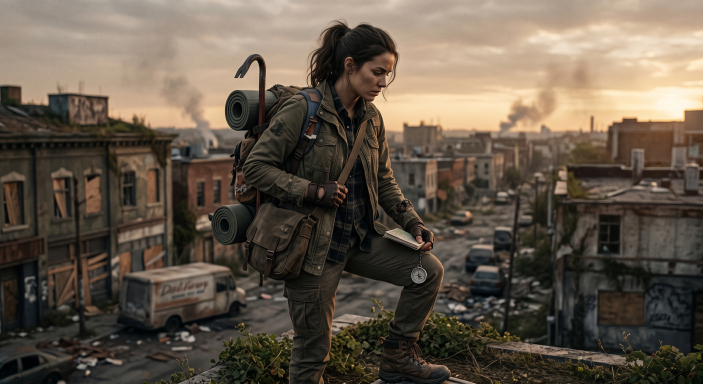
  • Clothing: Ditch the heavy tactical gear. You want lightweight, bite-resistant layers. Think thick leather jackets, heavy denim, and sturdy boots. Keep your hair cut short or tied back securely so it can’t be grabbed.

The Real Threat: In a true collapse, the minor things become lethal. A simple blister can turn into a systemic infection without antibiotics. Dysentery from dirty water will kill faster than a horde. Prioritize hygiene and medical supplies above ammo.

The best places to stage a survival camp


Staging a successful, long-term survival camp requires balancing multiple critical elements: defensive geometry, natural resource availability, population density, long-term sustainability, and human navigation. The “best” location changes depending on whether you are trying to survive the chaotic first 30 days or trying to build a permanent society. Depending on your primary survival strategy, these locations offer unique tactical advantages for riding out the collapse and depend on your geographical location/immediate needs.

1. The Immediate Fortress: Modern High Schools

While pop culture often points people toward shopping malls or police stations, those are massive traps. Malls have too many glass entry points, and police stations attract panicked, heavily armed crowds. A modern high school is a much better alternative.

  • The Blueprint: Post-1990s schools are built like low-profile fortresses. They feature heavy exterior doors, reinforced window frames, limited ground-floor glass, and commercial perimeter fencing.

  • Tactical Edge: Interior hallways allow for deep, lockable fallback positions if the perimeter fails. Roof access provides excellent overwatch for sentries.

  • Resources: School kitchens are stocked with bulk, non-perishable dry staples and massive canned goods that can sustain a group for months if strictly rationed. Furthermore, industrial arts/woodshop wings provide tools and materials to heavily fortify the structure.

2. The Isolation Play: Offshore Oil Rigs

If the goal is absolute detachment from the infected population, an offshore oil rig is the ultimate safe haven.

  • The Blueprint: A massive steel structure anchored miles out in the ocean or gulf.

  • Tactical Edge: Assuming zombies cannot swim, navigate open water, or climb vertical steel ladders, the threat of the undead drops to zero. The elevation offers an unobstructed 360-degree view of the horizon.

  • Resources: These platforms are engineered to support crews for months at a time. They feature advanced water desalinization systems, massive power generators, independent living quarters, and well-stocked medical bays. The primary drawback is that once the onboard food runs out, you are entirely dependent on open-sea fishing or high-risk supply runs to the mainland.

3. The Structural Ideal: Historic Stone Castles or Old Prisons

For those lucky enough to live near historic architecture, medieval stone castles or old-style fortresses built from thick stone and concrete are near-impenetrable.

  • The Blueprint: High vertical stone walls, deep moats, and narrow chokepoints (like drawbridges or portcullises) designed explicitly to repel ground-based sieges.

  • Tactical Edge: Zombies lack the cognitive ability or tools to scale or breach solid stone walls. A very small group of humans could easily hold off thousands of infected simply by securing the main gate.

  • Resources: The downside is that modern tourist castles do not come pre-stocked with food. However, maximum-security prisons with concrete walls offer a similar defensive profile while including modern plumbing, medical facilities, and massive interior courtyards.

4. The Long-Term Play: Rural Elevated Valleys & Ranches

For permanent survival, you must eventually transition from scavenging to agricultural production. This requires migrating to regions with low population density and high natural resource availability.

  • The Blueprint: High-altitude mountain valleys or sprawling rural ranches situated far from major highways and metropolitan zones.

  • Tactical Edge: Low population density means a drastically lower volume of zombies. Natural choke points, like steep cliffs or rocky terrain, can be paired with fencing to create simple but effective perimeters.

  • Resources: Access to natural flowing freshwater springs, arable soil for crop cultivation, and timber for fuel and building are mandatory for long-term endurance.

Crucial Camp Selection Checklist

No matter which structure you choose, a viable survival camp must satisfy four core pillars:

  1. Renewable Water: A camp without a natural well, spring, or advanced filtration system will fail within days, regardless of how strong the walls are.

  2. Clear Lines of Sight: Avoid dense brush right up against your perimeter. You need at least 50 to 100 yards of clear visibility to spot incoming threats.

  3. Multiple Escape Routes: A fortress can easily become a tomb if you are cornered. A camp must have at least two concealed, unobstructed exits for emergency evacuation.

  4. Agricultural Space: You cannot survive forever on canned beans. The camp must have a secure interior zone (like a school football field, a prison yard, or a flat roof) that receives enough sunlight to grow crops.

Good Luck, Have Fun, Don’t Die!

Share with