The Architecture of Fortune:
Why the Luckiest People Aren’t the Most Talented
We are conditioned to treat luck as a form of cosmic favoritism.
When things go spectacularly right for someone, we assume they possess a golden touch, an invisible, mystical shield that deflects hardship and attracts opportunity. When a life unravels through a series of bizarre coincidences, we blame a curse, a bad omen, or a hostile universe. We buy lucky charms, avoid walking under ladders, and treat randomness as a sentient force that chooses sides.
But if you strip away the superstition, science reveals a much more unsettling truth.
There is no cosmic dice roller picking favorites. What we call “luck” is actually uncontrolled variance, the massive, math-driven role that completely unpredictable events play in shaping our lives. And as it turns out, this randomness has far more power over your success than society wants to admit.
The Talent vs. Luck Paradox
In 2018, a team of researchers at the University of Catania in Italy decided to mathematically map the trajectory of human success. They created a massive computer simulation, tracking the 40-year careers of 1,000 virtual individuals.
Each person was given a normal distribution of “talent”, varying levels of intelligence, skill, and capacity for hard work. They were also exposed to a completely random series of “lucky” opportunities and “unlucky” setbacks over the course of their simulated lifetimes.
The researchers wanted to see if the most talented people naturally rose to the top. The results later won an Ig Nobel Prize for Economics in 2022 and shattered the myth of pure meritocracy: The most successful individuals in the simulation were almost never the most talented.
Instead, the top performers were consistently people of completely average ability who happened to encounter an extraordinary, consecutive run of positive random events. The most highly gifted individuals frequently ended up underperforming simply because they hit a streak of bad luck at critical pivot points.
Mathematically speaking, talent is just a baseline requirement to get into the game. The final score is overwhelmingly dictated by how the ball bounces.
The Hidden Receiver
This leaves us with a cynical conclusion: if life is entirely ruled by random variance, then human agency is an illusion. We are all just passive passengers at the mercy of a chaotic universe.
Except, that’s only half the story.
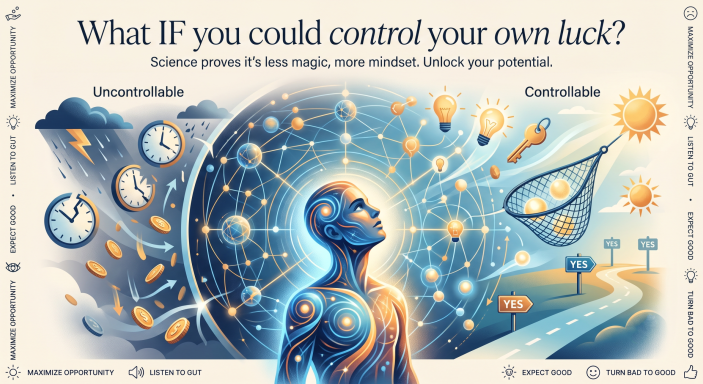
While you cannot control the raw mathematical variance of the universe, groundbreaking behavioral research shows that you can control how much of that variance you actually see. As it turns out, “lucky” and “unlucky” people aren’t experiencing a different physical reality. They are running entirely different internal software filters.
The universe is constantly broadcasting a chaotic stream of random opportunities. The question isn’t whether luck exists—the question is how you have calibrated your receiver.
The Attentional Filter: The Science of Living in a Blind Spot
In the 1990s, British psychologist Dr. Richard Wiseman set out to investigate the human side of the luck equation. If the universe operates on raw randomness, he reasoned, then “lucky” and “unlucky” people should experience a roughly equal distribution of random chance over time.
To test this, he recruited a pool of over 400 volunteers who identified as either chronically lucky (things always just work out) or chronically unlucky (if something can go wrong, it will). For ten years, he subjected them to personality inventories, diary tracking, and cognitive tests.
What he discovered permanently shifted the scientific conversation around fortune: Lucky and unlucky people do not live in different environments. They process the exact same environment through entirely different filtration systems.
The most vivid demonstration of this was Wiseman’s famous newspaper experiment.
The Newspaper Test
Wiseman handed participants from both groups a newspaper and gave them a simple, straightforward directive: Count how many photographs are inside.
The self-described “unlucky” participants took their time. They flipped through the pages methodically, scanning every column, carefully counting each image. On average, it took them about two minutes to complete the task.
The “lucky” participants finished the exact same task in a matter of seconds.
They didn’t just count faster; they stopped counting entirely. On the second page of the newspaper, taking up half the page in massive print, Wiseman had inserted a bold headline:
“Stop counting! There are 43 photographs in this newspaper.”
The lucky people saw it instantly. The unlucky people flipped right past it, their eyes moving over the giant text without their brains ever registering its meaning.
But Wiseman wasn’t finished. Halfway through the paper, he placed a second massive headline:
“Stop counting, tell the experimenter you have seen this, and win £150.” (Roughly $250)
Again, the unlucky group missed it entirely. The cash reward sat in plain, bold text directly in front of their eyes, rendered completely invisible by their own cognitive architecture.
The Anatomy of Inattentional Blindness
What happened in that laboratory is a psychological phenomenon known as inattentional blindness, the human brain’s tendency to miss completely obvious visual stimuli when it is hyper-focused on a specific task.
This isn’t an intellectual failure; it is a neurological survival mechanism. Every single second, your environment bombards your senses with roughly 11 million bits of raw data. Your conscious mind, however, can only process about 50 bits per second. To keep your brain from short-circuiting, your internal filter, the Reticular Activating System (RAS) must aggressively discard 99.9% of the world before it ever reaches your conscious awareness.
Wiseman’s data revealed that the width of this filter is directly dictated by your emotional baseline:
-
The Unlucky State (Constriction): Unlucky individuals scored significantly higher on generalized anxiety tests. When you operate in a state of low-grade, chronic stress or hyper-focus, your sympathetic nervous system triggers a physical and cognitive narrowing of your attentional spotlight. Your brain locks onto a rigid tracking system (like counting photos) and treats everything else as irrelevant background noise.
-
The Lucky State (Expansion): Lucky individuals operated with a much lower baseline of anxiety. Because their nervous systems were relaxed, their attentional spotlight remained wide and soft. They weren’t looking harder for opportunities; they were looking softer, which allowed their peripheral awareness to capture unexpected data points, like a shortcut to the answer or a cash prize.
The Invisible Reality
Outside the laboratory, the newspaper test runs 24 hours a day.
Every single day, the environment around you is printing massive, metaphorical headlines offering shortcuts, connections, creative breakthroughs, and sudden pivots. They sit on the pages of conversations you half-listen to, emails you skim, and daily commutes you navigate on autopilot.
Unlucky people walk through life convinced that the world is a barren landscape devoid of breaks. In reality, they are living inside a newspaper full of opportunities, they just can’t see the text.
The Synthesis: The Four Pillars of a Lucky Mindset
If luck is not a magical trait but a cognitive configuration, the obvious question follows: how do we alter the settings?
Dr. Wiseman’s research, paired with modern cognitive neuroscience, reveals that lucky individuals consistently operate on four foundational pillars. These are not inherited personality traits. They are distinct behavioral systems that dictate how the brain interfaces with the chaos of everyday life.
By understanding these pillars, we can begin to see exactly how the internal software constructs our external fortune.
1. Relaxed Awareness
Unlucky people suffer from a hyper-focused, defensive attentional spotlight. Lucky people, by contrast, operate in a state of relaxed awareness.
By maintaining a lower baseline of generalized anxiety, lucky individuals keep their nervous systems out of a defensive, sympathetic state (commonly known as fight-or-flight). This physiological relaxation widens their visual and cognitive field. Because they are not desperately scanning the environment for one specific path or threat, they are uniquely primed to notice the unexpected anomalies, coincidences, and casual opportunities that pass through their peripheral vision every day.
2. Intuitive Listening
Modern culture routinely instructs us to prioritize cold, analytical logic above all else. However, the data shows that lucky individuals heavily rely on their internal radar.
There is a deeply rational, neurological reason for this behavior. While your conscious mind can only process a meager 50 bits of information per second, your subconscious mind is actively processing roughly 11 million bits. Intuition is not a mystical, supernatural force. It is simply your subconscious operating system running high-speed statistical calculations based on a massive, hidden backlog of environmental data.
When a lucky person follows a gut hunch to attend an unplanned meeting or reply to an obscure message, they are leveraging an immense subconscious processing unit that standard analytical thinking cannot match.
3. Expectation Programming
Your core assumptions act as the calibration software for your cognitive filters. Lucky people carry a generalized, ambient expectation that the future will ultimately work out in their favor.
This is not naive, toxic positivity. It is a functional tool driven by confirmation bias. When you enter a new scenario expecting opportunities, your Reticular Activating System aggressively highlights data that confirms your belief.
This selective perception creates a powerful, self-fulfilling loop:
The Lucky Loop: Positive expectations drive relaxed, confident behaviors. These behaviors naturally invite open, cooperative responses from the people around you. The resulting positive outcomes then validate your original expectation, reinforcing the cycle.
Unlucky people run the exact same psychological mechanism, but they program the input with negative expectations. They brace for failure, which forces their brains to scan exclusively for threats, hostility, and dead ends.
4. Counterfactual Resilience
The final pillar reveals that lucky people are not magically immune to hardship. They lose clients, experience health crises, and watch projects fail at entirely normal statistical rates. The true differentiator is how their brains process adversity after it arrives.
Lucky people naturally utilize a psychological mechanism called downward counterfactual thinking. When a major setback occurs, their immediate cognitive instinct is to imagine how much worse the situation could have been (for instance, realizing that a broken leg could have easily been a fatal car crash).
This mental reframing breeds instant perspective and gratitude. It prevents the nervous system from spiraling into the tight, defensive contraction that generates inattentional blindness.
This maps cleanly onto advanced cognitive restructuring techniques, such as the philosophical practice of “revision,” where a person deliberately revisits a negative event in their imagination to alter the emotional imprint it leaves on their nervous system. By changing that internal imprint, they ensure that today’s misfortune does not freeze their perception and sabotage tomorrow’s opportunities.
The Actionable Takeaway: The 30-Day Luck Audit
Shifting your luck signature from a theoretical concept into a practical reality requires treating it like a fitness routine. You cannot change every deeply ingrained cognitive habit simultaneously. Doing so creates the exact low-grade mental friction that narrows your attention filter in the first place.
Instead, you need to run a targeted intervention. By auditing your current cognitive baseline, isolating your primary behavioral bottleneck, and committing to a single daily micro-habit, you can systematically recalibrate your internal receiver.
Here is how to set up your personal 30-day luck experiment.
The universe is entirely indifferent to our desire for good fortune, but it is boundlessly rich in random variance. You cannot alter the chaotic physics of the world around you, but by intentionally widening your gaze, you can ensure you finally stop stepping over the opportunities hiding in plain sight.
To start practicing today, you can use the exact protocol Dr. Wiseman designed for his Luck School. It is a simple, three-part daily routine that targets your mind’s attentional filters, expectation biases, and cognitive resilience.
Before you begin, Dr. Wiseman had his students sign a Luck Declaration. It is a psychological trick to build personal commitment:
The Luck Declaration
“I want to increase the luck in my life, and I am prepared to actively practice these techniques for the next 30 days.”
Once you have made that mental commitment, follow this morning-to-night sequence to prime your brain for opportunity.
Your Daily Luck Protocol
Why This Simple Routine Works
When you perform this routine daily, you are training your brain’s Reticular Activating System (RAS), the bundle of nerves at our brainstem that filters out “useless” information and highlights what we care about.
If you tell your brain you are unlucky, it filters for threats and failures. When you actively write down positive events and force yourself to find silver linings, you train your RAS to actively point out hidden cash on the sidewalk, unexpected career connections, and happy coincidences you used to walk right past.
A 7-day calendar of daily ‘Routine-Breaker’ challenge
Here is your 7-day schedule of simple, low-stakes routine breakers. Each challenge is designed to inject just enough randomness into your week to expand your Luck Surface Area without overwhelming your day.
Day 1: The New Route Challenge
-
The Action: Change your physical trajectory. Take a completely different street on your commute, walk down aisles in the grocery store you usually skip, or visit a coffee shop on the other side of town.
-
The Luck Mechanism: Humans are creatures of deep habit, meaning we look at the exact same scenery and faces every day. Changing your route exposes your brain to entirely new visual stimuli, billboards, shops, and people, instantly creating a fresh set of potential variables.
Day 2: The Left-Field Media Challenge
-
The Action: Consume information completely outside your echo chamber. Listen to a podcast on a topic you know absolutely nothing about (e.g., marine biology, ancient currency, competitive chess), or read a Wikipedia article using the “Random Article” button.
-
The Luck Mechanism: Innovation and “lucky breakthroughs” almost always happen at the intersection of two unrelated ideas. By feeding your brain random data, you give your mind new puzzle pieces to connect later.
Day 3: The Phone-Free Presence Challenge
-
The Action: During a transition period today, whether you are walking from your car to your office, sitting on public transit, or waiting in a long line, keep your phone completely in your pocket or bag. Keep your eyes up and observe your surroundings.
-
The Luck Mechanism: Unlucky people miss opportunities because they are looking down at their screens. By looking up, you notice the flyer for an interesting local event, see someone who needs help (a massive generator of social luck), or catch the eye of someone who might smile and start a conversation.
Day 4: The Weak-Tie Revival Challenge
-
The Action: Scroll through your text messages, LinkedIn, or phone contacts until you find someone you haven’t spoken to in at least a year. Send them a brief, zero-pressure text: “Hey! You randomly crossed my mind today. Hope you’re doing great, just wanted to say hello!”
-
The Luck Mechanism: Sociologists have proven that life-changing opportunities rarely come from our close friends (who know the same people and info we do). They come from “weak ties”, acquaintances who bridge the gap into entirely different social and professional networks.
Day 5: The “Coin-Flip” Decision Challenge
-
The Action: Today, outsource one low-stakes, daily decision to complete randomness. If you can’t decide between two lunch options, two outfits, or two books to read tonight, flip a coin and instantly commit to whatever the coin decides.
-
The Luck Mechanism: This forces you out of your standard analytical loop. It breaks down decision paralysis and pushes you down a path you might have otherwise talked yourself out of.
Day 6: The Standard-Bearer Conversation Challenge
-
The Action: Strike up a micro-conversation with someone whose role is often treated as invisible or purely transactional. Thank the bus driver, ask the barista how their shift is going, or compliment the cashier on their efficiency.
-
The Luck Mechanism: Being open and charismatic with the world creates a powerful psychological halo effect. You become memorable. The more people who view you positively, the more likely someone is to pass a recommendation, a tip, or an opportunity your way down the line.
Day 7: The “Say Yes” Default Challenge
-
The Action: For today only, if someone invites you to an event, asks for your help on a project, or suggests trying a new food, make your default answer “Yes”, provided it is safe, legal, and within your budget.
-
The Luck Mechanism: Our brains naturally lean toward comfort and saying “no” to save energy. By enforcing a “Yes” rule for a single day, you intentionally walk through doors that your comfort zone would normally keep firmly shut.
How to tracking your results
Keep your Luck Journal next to your bed this week. At the end of each day, write down the exercise you did and note if anything unusual, interesting, or positive happened as a result, even if it was just a funny interaction or a pleasant view. You will be surprised by how quickly the ripples begin to form.