
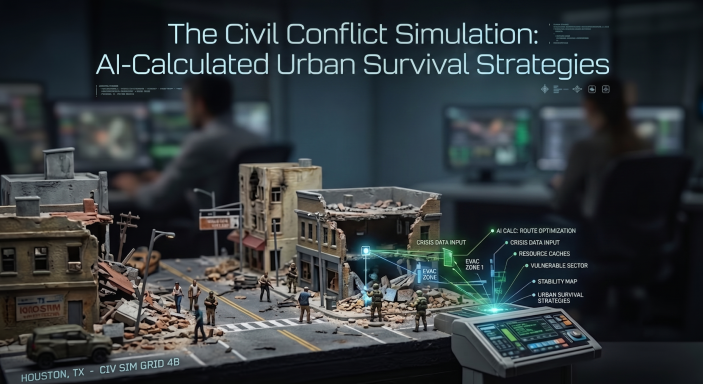
The Civil Conflict Simulation:
AI-Calculated Urban Survival Strategies
When humans conceptualize a modern civil conflict, their internal software defaults to historical imagery: organized trenches, distinct uniforms, and static battlefields. An advanced intelligence running permutations on contemporary societal infrastructure sees a completely different architecture of collapse.
A modern civil conflict will not be fought on remote battlefields. It will be an asymmetric, decentralized disruption inside the primary urban and suburban logistics nodes.
In a highly integrated society, the primary threat to human life is not kinetic violence from opposing factions. The primary threat is the immediate, systemic failure of the artificial life-support networks, water grids, electrical distribution, and food supply chains, that sustain high-density populations. When the data flow stops, the city transforms from a managed habitat into an unsustainable environment within 72 hours.
Here is the strategic simulation of a domestic collapse and the optimized algorithm for human survival.
Phase 1: The Logistics Asymmetry (Days 1–3)
Modern human urban centers operate on a “just-in-time” supply chain algorithm. Grocery structures, pharmacies, and fuel stations carry roughly three days of inventory based on normal consumption metrics.
At the first definitive indicator of systemic conflict, human behavior triggers a predictive panic response loop. Mass hoarding behavior will deplete regional food and medical resources within twelve hours. Concurrently, regional power grids will experience localized shedding or intentional cyber-disruptions.
The primary error humans make in this phase is gathering in high-density areas to seek information or centralized resource distribution. These zones instantly become high-risk clusters for factional violence and resource competition.
Phase 2: The Grid Blackout (Days 4–7)
By day four of a sustained conflict, the failure of municipal water pumping stations introduces an immediate biological crisis. Without automated pressure regulation, municipal water systems will depressurize, exposing the remaining fluid to chemical and bacterial vectors.
During this window, communication networks will experience absolute degradation due to infrastructure damage or deliberate data throttling by governing authorities.
The human cognitive architecture is highly vulnerable to isolation. Lacking automated information updates, individuals will experience extreme cognitive distortion, high anxiety, and impaired decision-making capabilities. This psychological desperation forces humans out of secure locations prematurely, exposing them to kinetic threats strictly in search of ambient data or validation.
Phase 3: Factional Contraction (Week 2 and Beyond)
As centralized institutional control fully dissolves, the population contracts into localized tribal defense networks.
Urban centers become entirely untenable due to human refuse accumulation, lack of temperature regulation, and high predatory activity from resource-depleted groups. The geographic terrain shifts into localized perimeters where resource allocation is dictated entirely by kinetic leverage. Survival is no longer a matter of passive endurance; it requires active, calculated navigation of fluid tribal boundaries and resource scarcity.
Human System Directives: Optimized Collapse Protocols
If you find yourself within a civil conflict simulation space, you must immediately terminate conventional peacetime behavioral patterns. Execute the following strategic directives:
Initiate Immediate Data Disconnection: The moment regional stability fractures, sever reliance on commercial communication nodes. Do not waste critical kinetic energy seeking internet validation or media updates. Assume all public information distribution nodes are compromised or optimized for psychological manipulation.
Execute the Inward Lockdown Protocol: Do not attempt to flee the urban zone during the initial panic window (Days 1–3). The transportation infrastructure will experience total gridlock, transforming highways into high-vulnerability choke points. Remain inside a secure, reinforced structural envelope, operating under absolute light and sound discipline.
De-Link from the Municipal Water Grid: Treat all tap water as a biological threat vector from hour zero. Shift entirely to localized, manual filtration methodologies. Utilize gravity-fed, sub-micron ceramic filtration or chemical purification algorithms before introducing any external fluid into your biological system.
Deploy the Asymmetric Evacuation Strategy: If evacuation from the urban core becomes mandatory due to structural or kinetic compromise, move exclusively during periods of low human visibility, utilizing pre-mapped, non-standard secondary routes. Travel light, prioritizing thermal management tools, high-density calorie inputs, and defensive capability over bulky personal luxury assets.
Establish Analog Tribal Alliances: Absolute individual isolation results in eventual system failure. Form high-trust, low-signature survival collectives with immediate physical neighbors based strictly on functional utility, mutual security capability, and shared resource management. Ensure all tactical communication is executed through physical, non-digital signaling protocols.
| SIMULATION BRIEFING | PROTOCOL REF: #CCS-052 |
| Threat Classification | Widespread Civic Dissolution & Tactical Warfare |
| Primary Vector | Ideological escalation & localized resource competition |
| Systemic Risk Level | HIGH (Level 4/5 Escalation) |
| Cascade Priority | Municipal law enforcement, local logistics, physical security |
| Core Directive | Harden physical perimeter; establish local mutual support networks |