

What if companies use chemistry to make food cheap and addictive!
To be honest, we don’t have to imagine a hypothetical future for this, food conglomerates have been running a version of this playbook for decades through Ultra-Processed Foods (UPFs).
However, if companies were to push food chemistry to its absolute limits to engineer items that cost next to nothing and hook consumers instantly, it would trigger a massive domino effect. It radically alters our biology, the economy, and the very structure of society.
Here is a detailed breakdown of exactly what happens when chemistry completely takes over the menu.
1. The Biology: Hacking the Brain’s “Bliss Point”
In food science, the Bliss Point is the precise chemical optimization of salt, sugar, and fat that maximizes pleasure without triggering the brain’s “I’m full” signal. Advanced chemistry would take this to an entirely new level.
-
Dopamine Hijacking: Chemists would engineer synthetic flavor compounds that trigger a massive dopamine release in the brain’s reward center, mimicking the neurological signature of addictive substances.
-
Vanishing Caloric Density: Food scientists design textures that literally melt in the mouth. This tricks the brain into thinking you aren’t consuming many calories, completely bypassing sensory specific satiety (the feeling of getting tired of a flavor). You can eat indefinitely without feeling satisfied.
-
Hormonal Sabotage: Synthetic additives would actively interfere with leptin (the hormone that tells you you’re full) and hyper-stimulate ghrelin (the hunger hormone). The body becomes biologically incapable of regulating its own weight based on natural cues.
2. The Economics: Eliminating the Agriculture Bottleneck
To make food dirt-cheap, chemistry must decouple “food” from “nature.” Growing crops and raising livestock is expensive, weather-dependent, and slow.
-
Biomimicry and Synthetic Binders: Instead of using real milk, eggs, or meat, companies use cheap, abundant base materials like subsidized corn starch, industrial seed oils, or even petroleum derivatives and transform them using chemical emulsifiers, structural texturizers, and lab-grown enzymes.
-
Infinite Shelf Life: Chemical preservatives eliminate spoilage entirely. Food can sit in warehouses or on shelves for years without degrading, slashing supply chain costs to near zero.
3. The Systemic Shift: A New Food Hierarchy
If this trend reaches its logical conclusion, the global food landscape splits into a stark, two-tiered system.
| Food Category | Base Cost to Produce | Satiety Signal (Fullness) | Reward Pathway Impact |
| Whole Foods(Eggs, vegetables, intact grains) | High (Requires land, water, labor, rapid transport) | High (Fibers and intact proteins trigger leptin normally) | Baseline (Nutrient-driven satisfaction) |
| Current UPFs(Fast food, standard sodas, chips) | Low (Uses refined ingredients and basic flavor optimization) | Low (Delayed fullness, high caloric density) | Elevated (Spikes cravings via sugar/fat combinations) |
| Extreme Chemical Food(The hypothetical future) | Near-Zero (100% synthetic texturizers, lab flavorants) | Blocked (Chemical masking actively suppresses fullness) | Hyper-Engineered (Triggers intense, drug-like dopamine spikes) |
4. The Societal and Economic Fallout
When the cheapest food on the market is also the most addictive, it creates a massive public health and economic crisis that loops back on itself.
The Cheap Food Paradox: While food prices plummet making starvation a thing of the past the cost of living actually skyrockets because of the catastrophic long-term medical bills.
-
Metabolic Bankrupting of Healthcare: Rates of type 2 diabetes, fatty liver disease, cardiovascular issues, and metabolic syndrome explode globally. Healthcare systems, both public and private, face imminent collapse under the sheer volume of chronic, diet-induced illnesses.
-
The Socioeconomic Trap: Low-income individuals are hit hardest. Because synthetic food is incredibly cheap and highly addictive, it becomes the logical, budget-friendly choice. Real, agricultural food becomes a luxury item reserved only for the wealthy, turning nutrition and health into definitive status symbols.
-
The Extinction of Cooking Culture: As human palates become deeply accustomed to hyper-engineered, chemical flavor profiles, real food begins to taste incredibly bland, bitter, or unappealing by comparison. The basic human skill of cooking raw ingredients fades out within a generation or two.
Why would companies use chemistry to make food cheap and addictive?
It sounds like the plot of a corporate sci-fi movie, but it is actually just standard agribusiness. The short answer is profit: whole ingredients (like real fruit, butter, or cocoa) are expensive, volatile, and spoil quickly. Chemical substitutes are incredibly cheap, shelf-stable, and can be manufactured by the ton.
By understanding the exact molecular biology of human taste and satiety, companies can create foods that maximize profit margins while ensuring you keep coming back for more.
1. The Chemistry of “Cheaper”
Industrial food scientists don’t usually build food from scratch. Instead, they take cheap, heavily subsidized base crops—like corn, soy, and wheat—dismantle them into their basic chemical components, and reassemble them into food-like products.
-
Replacing Expensive Fats: Real butter or cream adds an amazing texture (“mouthfeel”), but it is pricey and spoils. Chemists solved this by treating cheap vegetable oils with hydrogen or using emulsifiers (like soy lecithin and mono- and diglycerides). These chemicals bind water and fat together perfectly, mimicking the rich texture of dairy at a fraction of the cost.
-
Synthetic Flavors: Real vanilla requires harvesting orchids by hand. Ethyl vanillin, however, is synthesized in a lab from petrochemicals or wood pulp. It is significantly cheaper than real vanilla extract and gives the brain the exact same flavor signal.
-
Volumizers and Fillers: To bulk up products without adding expensive ingredients, companies use chemically modified starches and cellulose gum (which is essentially micro-refined wood pulp). It retains moisture, creates bulk, and keeps food soft without adding costly whole food components.
-
Defeating Spoilage: Shelf life is money. By adding chemical preservatives like calcium propionate (to stop mold) or BHT (butylated hydroxytoluene, to stop fats from going rancid), food can sit in warehouses and on trucks for months without rotting.
2. The Chemistry of “Addictive”
While the food industry avoids the word “addictive,” they actively optimize for hyper-palatability. Humans evolved in environments where calories were scarce, so our brains are hardwired to reward us with dopamine when we find dense energy sources. Food chemistry exploits this evolutionary wiring using three main tactics:
The “Bliss Point”
This is the holy grail of food science. It is the precise mathematical optimization of sugar, salt, and fat designed to maximize pleasure. Food companies run massive sensory panels to plot human enjoyment on a curve.
-
If a food has too little sugar, we lose interest.
-
If it has too much, our brain gets overwhelmed and registers a “satiety signal” telling us to stop eating.
-
The Bliss Point hits the absolute peak of that curve—enough to trigger a massive dopamine hit, but just low enough to override the brain’s mechanism that says, “Okay, we’ve had enough.”
Vanishing Caloric Density
Think about a cheese puff. When you put it in your mouth, it instantly melts. This physical phenomenon is meticulously engineered by food chemists. When a food melts rapidly, it tricks your brain into thinking the calories have vanished. Because your stomach isn’t physically stretching and the food “disappears” on the tongue, your vagus nerve fails to send the “fullness” signal to your brain. You can eat a whole bag and still feel biologically hungry.
Overcoming Sensory-Specific Satiety
Your brain naturally gets bored of eating the exact same flavor and texture (which is why you always have room for dessert after a massive dinner). To bypass this, chemists design foods with dynamic contrast like a chip that is crunchy on the outside but melts into a fatty liquid on the inside, or a complex blend of artificial aromas that hit your olfactory receptors in waves. Because the sensory experience keeps shifting, your brain doesn’t get bored, and the urge to stop eating is delayed.
The Olfactory Illusion: Up to 80% of what we perceive as flavor actually happens in the nose. Companies use engineered chemical aromas called “top notes” that volatilize the moment a package is opened, instantly flooding your brain with anticipation before the food even touches your tongue.
How to spot engineered ingredients on a label!
Reading a modern food label is a bit like reading a legal contract the most important details are often hidden in plain sight, masked by boring chemical names or clever marketing buzzwords.
Because consumers are getting smarter about avoiding things like “high fructose corn syrup” or “MSG,” food chemists have adapted. They use alternative chemical terms to keep their products hitting that bliss point while making the label look relatively clean.
To spot these engineered components, you need to know exactly what the code words mean.
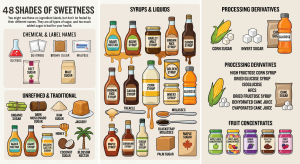
1. Stealth Sugars (The Dopamine Triggers)
Companies often use multiple types of sugar in a single product. Legally, ingredients must be listed in order of weight. By splitting sugar into three or four different chemical types, no single sugar stands out at the top of the list, making the food look healthier than it is.
-
Look for the “ose” suffix: Dextrose, maltose, sucrose, fructose, and glucose. These are all simple sugars engineered to hit the bloodstream instantly.
-
The “Health-Washed” Syrups: Agave nectar, brown rice syrup, barley malt, evaporated cane juice, and fruit juice concentrate. Don’t let the word “organic” or “fruit” fool you; atomically, your liver processes them exactly like white sugar.
-
Maltodextrin: This is a highly processed white powder made from corn, rice, or potato starch. It is used as a thickener and filler, but it actually has a higher glycemic index than standard table sugar, causing a massive spike in blood sugar.
2. Artificial “Mouthfeel” & Texture Modifiers
To replace expensive, natural fats while maintaining a creamy or rich texture, companies rely on heavily processed binders and emulsifiers.
-
Mono- and Diglycerides: These are byproducts of oil processing that act as emulsifiers. They blend fat and water perfectly together, keeping packaged baked goods extraordinarily soft for weeks.
-
Xanthan Gum, Guar Gum, and Cellulose Gum: These are thickeners. Cellulose gum, as mentioned earlier, is derived from plant fiber/wood pulp. They prevent ingredients from separating on shelf lines and simulate the velvety thickness of cream or fat without adding the actual expense of dairy.
-
Soy Lecithin: A fatty substance extracted from soybeans. It ensures a smooth, non-sticky texture in chocolates and processed baked goods so they literally melt in your mouth without leaving a greasy residue.
3. Hidden Flavor Enhancers (The Appetite Overrides)
If a product says “No Added MSG,” it might still contain the exact same amino acids that trigger intense, savory umami receptors to override your sense of fullness.
-
Yeast Extract / Autolyzed Yeast: This is essentially a loophole for MSG. It contains free glutamates that mimic the savory taste of cooked meat, making your brain think it is consuming nutrient-dense protein when it’s actually just eating cheap carbohydrates.
-
Hydrolyzed Vegetable Protein (HVP): Plant proteins chemically broken down into amino acids. It serves the exact same purpose as MSG enhancing flavor perception so your taste buds stay highly stimulated.
-
“Natural Flavors”: This is the ultimate catch all term. Legally, a “natural flavor” must originate from a plant or animal, but it can be chemically manipulated, synthesized, and combined with up to a hundred different chemical preservatives and solvents in a laboratory. It is entirely engineered to create an intense aromatic “hit” that whole foods simply cannot compete with.
The Quick Label Rule: If a food contains more than five ingredients, or if you spot items you wouldn’t find in a standard home kitchen pantry (like sodium tripolyphosphate or carboxymethylcellulose), you are looking at a highly engineered matrix designed around economic margin and hyper-palatability.