
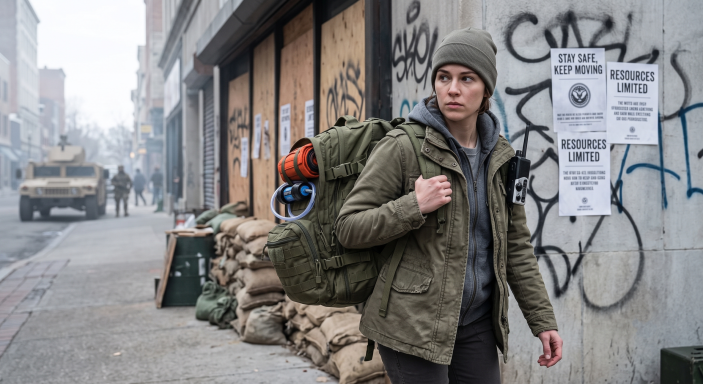
If a modern civil conflict were to break out, what would be the best way to survive?
If a worst-case scenario like a modern civil conflict were to break out, the reality of survival would look a lot less like a Hollywood action movie and a lot more like dealing with massive supply chain collapses, utility blackouts, and localized unrest.
Your primary objective in any civil clash isn’t taking a side, it’s staying out of the crossfire and securing your immediate household. Historically, in civil conflicts, the people who survive are those who prioritize logistics, anonymity, and adaptability over ideology.
Here is a practical, grounded blueprint for navigating a major societal breakdown.
1. Secure the Essentials (The Logistics of Survival)
When systems fail, the grocery store shelves empty in hours, and utilities can go dark. You want to secure your basic needs before any active conflict reaches your doorstep.
-
Water: This is your absolute limit. Aim for at least one gallon of water per person per day. Keep a combination of stored water, gravity filters (like Sawyer or Lifestraw), and purification tablets.
-
Food: Stock up on non-perishable, calorie-dense foods that require minimal or no cooking (canned meats, beans, rice, peanut butter, oats).
-
Medicine: Stock a minimum of a 30-day supply of any critical prescription medications. Beyond that, a robust first-aid kit with trauma supplies (tourniquets, chest seals, pressure bandages) is vital, as emergency services may be delayed or non-existent.
-
Power & Light: Invest in solar power banks, rechargeable headlamps, and a manual hand-crank radio.
2. Make the Critical Decision: Stay or Go?
One of the first decisions you’ll face is whether to hunker down (shelter in place) or bug out (evacuate).
When to Hunker Down
If you live in a suburban or rural area, have a well-stocked home, and the local area is relatively quiet, staying put is usually the safest option. Moving on foot or in a vehicle during a crisis exposes you to road blockages, fuel shortages, and desperate people.
When to Bug Out
If you live in a high-density urban center where supply chains are entirely cut, or if active violence reaches your immediate neighborhood, you need to leave.
-
Have a predetermined destination (like a relative’s home in a safer region). Never leave just to “wander.”
-
Keep your vehicle’s gas tank at least half full at all times.
-
Have a “Go-Bag” packed with 72 hours of food, water, clothing, and critical documents.
3. Adopt the “Gray Man” Concept
In a highly polarized conflict, drawing attention to yourself is dangerous. The “Gray Man” concept is about blending into your environment so completely that no one remembers seeing you.
Aggressive Neutrality: Remove any bumper stickers, flags, or political signs from your car and home. Dress in plain, neutral-colored clothing. Avoid tactical-looking gear that might make you look like a combatant or a high-value target carrying expensive supplies.
Keep your head down, do not engage in online or local debates, and don’t advertise what resources (food, water, power) you have at home. Desperation makes people observant.
4. Maintain Information Flow
In a conflict, rumors and misinformation spread faster than the actual violence. Having reliable ways to gather information is crucial for deciding when to move or when to lock down.
-
Communications: Keep a battery-powered or hand-crank AM/FM radio to listen to emergency broadcasts. If cellular networks go down, a family radio service (FRS) or ham radio can be highly valuable for local communication.
-
Offline Maps: Download offline versions of your local and state maps on your phone (using apps like Organic Maps or Google Maps offline). Keep a physical road atlas in your car in case electronics fail.
5. Build Local Alliances
While isolation feels safe, long-term survival in a crisis is nearly impossible alone. You cannot stay awake 24/7 to guard your home, nor can you possess every skill needed to survive.
Get to know your immediate neighbors now. You don’t need to share the same political views to agree on mutual defense, sharing resources, or keeping an eye out for security threats in your neighborhood. True security is built on local, face-to-face trust.
Strategic differences between a high-density urban area vs a rural area
Surviving a major societal breakdown looks radically different depending on your geography. A high-density city presents a high-intensity, time-sensitive crisis, while a rural environment presents a slower, long-term test of endurance. There is no perfect safe zone, each environment simply trades one set of lethal risks for another.
Here is how the strategic realities split down the middle.
Core Comparison: Urban vs. Rural Survival
| Metric | High-Density Urban | Remote / Rural Area |
| Primary Threat | Human density and rapid resource depletion | Extreme isolation and total lack of emergency services |
| Water Access | Highly vulnerable (relies entirely on a pressurized, powered grid) | Higher availability (wells, natural streams, rain collection) |
| Food Runway | 3 to 5 days max (dependent on just-in-time grocery supply chains) | Weeks to months (deep pantries, livestock, local farming) |
| Security Dynamic | High-risk, close-quarters; concealment and anonymity are key | Lower immediate threat, but large perimeters are hard to defend alone |
| Sanitation & Health | Critical risk (rapid sewage backup, trash pileups, disease spread) | Manageable risk (easier waste diversion and physical distance) |
| Mobility | Minimal; high risk of gridlock, choke points, and blockades | High freedom of movement, but requires significant fuel reserves |
The Urban Environment: A Survival Countdown
In a city, your strategy is dictated by a clock. High-density areas operate on a “just-in-time” logistics system. The moment trucks stop delivering and the power goes out, the countdown begins.
-
The Sanitation Trap: Most people focus on food and defense, but the silent killer in a city breakdown is sanitation. When high-rises lose power, water pumps fail, meaning toilets won’t flush. Within 72 hours, human waste and uncollected garbage create a massive biohazard threat, drastically increasing the risk of waterborne diseases like cholera.
-
Vertical vs. Horizontal Security: In an apartment or condo, security is vertical. You only have to secure a front door and perhaps a fire escape, making it easier to fortify against casual threats. However, you are entirely dependent on the structural integrity of the building. If a fire starts downstairs, your escape routes are highly limited.
-
The Anonymity Strategy: Because you cannot outfight a city full of desperate people, survival relies on camouflage. You must blend in, keep your lights blacked out at night, and never smell like cooking food if your neighbors are starving.
The Rural Environment: A Test of Self-Reliance
In the country, the immediate pressure is much lower, but the long-term demands are exhausting. The primary trap of rural survival is the illusion of total safety.
-
The Tyranny of Distance: In a rural area, you are entirely on your own. If you suffer a severe injury or medical emergency, specialized medical help is hours away or completely unavailable. A simple infection that a city clinic could treat in 15 minutes can become life-threatening.
-
The Perimeter Defense Dilemma: While you won’t deal with roving crowds, a rural property has multiple approach angles. A single family cannot guard a farmhouse, outbuildings, and acreage 24/7. Rural survival requires shifting from individual defense to community defense; pooling resources with neighboring farms to establish early warning networks.
-
Resource Management: While you have space for wood stoves, livestock, and gardens, getting those resources to work requires intense physical labor. If you don’t have fuel for tractors or chainsaws, you are burning manual calories faster than you can replace them.
The Strategic Takeaway: Urban survival is a sprint, you either secure a highly fortified position with a strict exit plan, or you evacuate before the choke points lock down. Rural survival is a marathon, it requires deep physical stamina, diverse practical skills, and a tight-knit local community to sustain life over months or years.