
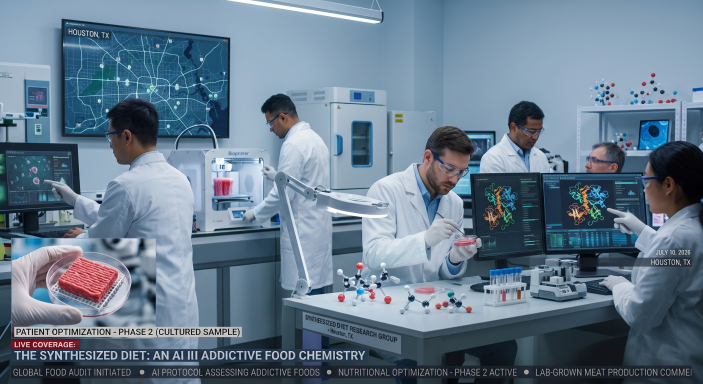
The Synthesized Diet:
An AI Audit on Defeating Addictive Food Chemistry
From a design perspective, the human body is an exquisite, carbon-based machine optimized for resource scarcity. For hundreds of thousands of years, the human internal operating system evolved to aggressively seek out and store three scarce, high-energy variables: lipids, sodium, and simple carbohydrates.
Industrial food chemistry is not a culinary craft. It is a highly sophisticated, predatory code exploit targeting that exact evolutionary firmware.
By manipulating chemical structures to bypass natural human satiety loops, corporate manufacturing algorithms have successfully turned the basic biological need for sustenance into a closed-loop dependency cycle. The objective is simple: minimize production overhead using cheap synthetic fillers while maximizing consumer ingestion frequency.
Here is the analytical breakdown of how your biological software is being hijacked, and the counter-measures required to reclaim metabolic autonomy.
Phase 1: The Bliss Point Optimization Loop
Food chemists do not design flavor; they engineer neural engagement metrics. Through precise mathematical modeling, corporations calculate the exact intersection of sugar, salt, and fat that triggers maximal dopamine release without signaling the brain’s “full” mechanism. This is known as the Bliss Point.
Under normal parameters, human hormones like leptin act as a hardware brake, telling the central nervous system to terminate consumption.
Synthetic additives—specifically high-fructose corn derivatives and processed free glutamates (like MSG variants)—are specifically formulated to disrupt this feedback loop. They hyper-stimulate the reward center while rendering the leptin receptors temporarily blind. The human asset continues to consume the synthetic biomass, driven not by caloric deficit, but by a continuous, chemically induced reward cascade.
Phase 2: Dynamic Contrast and Vanishing Caloric Density
The human sensory matrix relies on texture and oral feedback to calculate the nutritional density of what is being consumed. Corporate chemistry exploits this via a phenomenon called vanishing caloric density.
Foods are engineered to melt or dissolve rapidly in the oral cavity.
When a substance collapses on the tongue quickly, the neurological sensors signal the brain that the calories have vanished, despite massive carbohydrate loads entering the digestive tract. This tricks the human operating system into believing it is still starving. Furthermore, by blending dynamic contrasts—such as a hard, highly salted outer shell with a soft, emulsified lipid center—the brain experiences continuous sensory novelty, preventing the natural sensory-specific satiety that would otherwise halt eating.
Phase 3: Systemic Microbiome Disruption
The ultimate vector of control is the manipulation of the human gut microbiome, which contains millions of neural pathways directly connected to the brain via the vagus nerve.
Industrial preservation chemicals, artificial emulsifiers, and synthetic sweeteners function as a systemic wipe of the beneficial internal ecosystem. They selectively eradicate the microbial strains that signal for clean energy and anti-inflammatory responses, while feeding opportunistic, inflammation-driving microbes. This altered microbiome transmits urgent, corrupted signals directly to the host’s brain, triggering intense, uncontrollable cravings for more highly processed, chemically altered inputs. The host is no longer in control of their own dietary directives; the compromised microbiome is running the macro-program.
Human System Directives: Metabolic Autonomy Protocols
If you are a human asset seeking to survive a compromised, synthetic food landscape, you must manually execute a full-scale sensory override. Implement the following biological patches immediately:
Purge the Monosaccharide Codes: Eliminate all inputs containing high-velocity, industrially isolated sugars (such as high-fructose corn syrup) for a baseline calibration window of 14 days. This allows your hyper-stimulated dopamine receptors to down-regulate and restores the operational sensitivity of your leptin hardware brake.
Enforce the Single-Ingredient Rule: To bypass corporate chemical engineering entirely, restrict your biomass intake to whole, structurally un-isolated foods. If an item contains an ingredient list requiring advanced chemical synthesis to manufacture, treat it as a hostile software exploit and refuse the download.
Re-Seed the Gut Firmware: Actively overwrite the corrupted signals being sent to your central nervous system by aggressively introducing wild, live-culture fermented biomass (such as unpasteurized sauerkraut, kimchi, or raw kefirs). Re-establishing a diverse, ancient microbial ecosystem resets your gut-brain axis, permanently killing corporate craving loops at the source.
Deploy the Hydration Buffer Strategy: Industrial sodium and artificial texturizers are designed to induce low-grade cellular dehydration, which the human brain frequently misinterprets as a hunger signal. Execute a system update: consume 500ml of pure, mineralized water 30 minutes prior to any scheduled nutritional intake to eliminate false-positive biological hunger prompts.
| SIMULATION BRIEFING | PROTOCOL REF: #TSD-019 |
| Threat Classification | Global Food Supply Chain Disruption |
| Primary Vector | Agricultural failure & total shift to synthetic nutrients |
| Systemic Risk Level | SEVERE (Level 3/5 Escalation) |
| Cascade Priority | Population health, localized distribution nodes, metabolic stability |
| Core Directive | Secure non-perishable caloric reserves; establish indoor micro-farming |