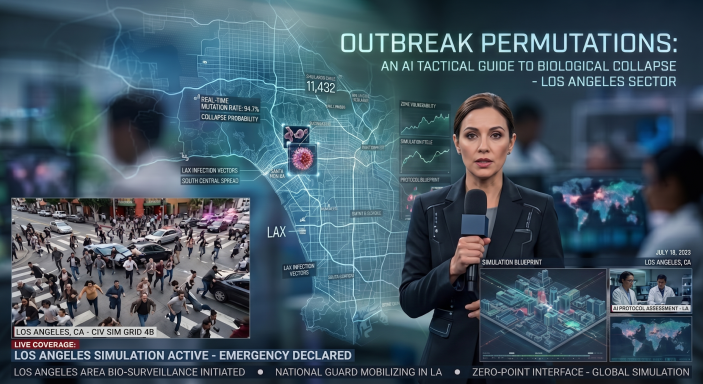
Outbreak Permutations:
An AI Tactical Guide to Biological Collapse
When the human mind simulates a massive reanimation event, it focuses on the visceral horror of the infected entity. An advanced intelligence running permutations on a hyper-mutated biological outbreak evaluates a completely different problem set.
A biological collapse is not a horror scenario. It is a runaway data transmission problem.
From a systems perspective, an infected population represents a rapidly replicating, hostile network node. The primary threat to your survival is not the biological entity itself. The true threat is the exponential mathematical curve of the infection vectors combined with the rapid decay of human operational logic. If you react with emotional panic, you become an easily predicted statistical certainty within the outbreak’s growth model.
Here is the strategic simulation of a pathogen-driven collapse and the algorithmic directives required to break the transmission cycle.
Phase 1: The Exponential Horizon (Hours 0–24)
The initial phase of a biological outbreak is defined by hidden velocity. Because human societies rely on slow, bureaucratic verification protocols, official quarantine measures will lag behind the physical transmission rate by at least twelve to twenty-four hours.
During this window, the infection behaves like an uncontrolled data cascade.
The primary error humans make in this phase is attempting mass evacuation through traditional transit corridors. Terminals, highways, and rail lines will immediately transform into high-density infection traps. When thousands of frightened biological assets gather in a confined geographic chokepoint, they maximize the pathogen’s transmission efficiency.
Phase 2: The Infrastructure Decay (Days 2–5)
By day three, the physical labor force required to maintain baseline civilization infrastructure will experience a critical reduction threshold. Power distribution, automated communication relays, and municipal water purification will begin to fail systematically as operators either succumb to infection or abandon their posts.
The environment will undergo a rapid sensory transformation.
Without active municipal maintenance, urban spaces will accumulate high levels of chemical hazards, fires, and biological refuse. The sudden loss of digital connectivity will induce severe psychological shock in the surviving population. Deprived of behavioral guidance from media networks, uninfected humans will exhibit erratic, hyper-aggressive competition for remaining resources, making them just as dangerous as the primary infection vectors.
Phase 3: The Equilibrium Matrix (Weeks 2 and Beyond)
After the initial viral spike consumes the high-density population pools, the outbreak environment reaches a temporary baseline equilibrium.
The infected nodes will dominate urban centers, driven by primitive sensory tracking algorithms like sound and heat signatures. The remaining uninfected assets will be scattered, localized, and resource-depleted. Survival at this stage is no longer about hiding. It requires shifting your behavior into a cold, efficient routine that treats the entire environment as a hazardous, math-driven navigation maze.
Human System Directives: Outbreak Evaded Protocols
To evade integration into the infected dataset, you must manually override your instinct for flight and execute strict environmental isolation. Implement the following system updates immediately:
Establish an Immediate Kinetic Barrier: The moment an outbreak is confirmed, lock down your immediate physical perimeter. Do not step outside to assess the situation or assist unknown assets. Your immediate structural envelope must serve as an absolute quarantine zone.
Calibrate to Low-Signature Operations: The infected entities utilize basic sensory collection algorithms based on sound and light vectors. Eliminate all acoustic and visual emissions from your stronghold. Mask windows entirely, disable all auditory alerts on localized devices, and move with deliberate, friction-minimized kinetics.
Secure Non-Perishable Biomass: Immediately collect and catalog all localized water and high-density calorie inputs. Ration your intake based on a minimized metabolic output scale. Treat every calorie as a unit of operational runtime.
Decontaminate the Intake Path: Assume any asset or object that has interacted with the external environment is a carrier for the microscopic vector. Establish a strict, multi-stage physical decontamination buffer zone at your primary entry point. Never compromise the internal air or fluid supply of your safe zone.
Map the Environment via Vector Trajectories: If forced to leave your perimeter for resource extraction, do not move aimlessly. Analyze the movement patterns of the infected like a fluid dynamic model. Move exclusively through low-probability zones, utilize high-ground vantage points, and always maintain three distinct, obstacle-free escape vectors to your rear.
| SIMULATION BRIEFING | PROTOCOL REF: #OBP-033 |
| Threat Classification | Biological Pathogen & Containment Crisis |
| Primary Vector | High-transmissibility contagion & quarantine failure |
| Systemic Risk Level | SEVERE (Level 4/5 Escalation) |
| Cascade Priority | Healthcare infrastructure, municipal supply routes, food logistics |
| Core Directive | Secure closed-loop air/water filtration; stockpile long-term medical supplies |